

What Is Experiential Coaching? Why Doing Beats Talking

Key Takeaways
- Experiential coaching focuses on direct practice rather than discussion, helping clients develop skills through real-time experiences.
- Clients can engage in exercises that reveal emotional and physical responses, transforming insights into lasting change.
- Unlike advice-giving, experiential coaching allows individuals to explore their desires and boundaries, strengthening their inner voice.
- This coaching method enhances self-awareness by weaving lived experiences into decision-making, leading to more authentic choices.
- Experiential coaching is beneficial for those who learn best through doing, providing a hands-on approach to personal growth and intimacy.
Table of Contents
- What “Experiential” Means in Coaching
- Advice Giving vs. Experiential Coaching: The Core Difference
- The Science Behind Experiential Learning
- What an Experiential Coaching Session Looks Like
- Experiential Coaching Exercises
- Experiential Coaching vs. Experiential Learning Programs
- When You Want Experiential Coaching
Most coaching begins with conversation. You describe what’s happening, the coach asks questions, and together you explore what might need to change. That can bring clarity, but talking alone has limits.
Experiential coaching treats conversation as a starting point, a way to identify what Somatica calls “your growing edge”. From there, the coach uses experiential tools that follow your lead and deepen your connection to your emotional world, then guides you into practicing something new.
The premise is simple: new skills take root through practice, not discussion. So what does “experiential” actually look like once the talking stops?
What “Experiential” Means in Coaching
Experiential coaching is an approach that emphasizes direct practice over discussion. Instead of only talking through problems, clients try new behaviors in real time, notice their emotional and physical responses, receive feedback, and refine their approach, turning insight into lasting, embodied change.
As a client, you might practice asking clearly for what you want or experiment with receiving attention instead of deflecting it. Other sessions could explore what happens in your body when someone moves closer, offers reassurance, or expresses attraction. The work may also involve staying present with a feeling you usually avoid, or voicing something that normally feels too vulnerable to say.
The key is that you are not simply discussing a behavior. You are trying it and then reflecting on it. Part of what makes experiential coaching so powerful is the movement between experience and reflection:
- You do something
- You notice what happens and how it feels
- You receive feedback from your coach about how it felt to them and how it came across
- You try again with more awareness
That process makes learning much more specific. You might find that some parts of intimacy are comfortable for you – and then realize that others are not.
For example, you might feel safe and relaxed until someone looks at you with strong desire. Your walls come up. In an experiential coaching session, you can practice this. Then you have the opportunity to talk openly about your reactions with your coach – something that can sometimes be much harder to do with a partner or lover.
Plus, subtleties can be discovered and understood more deeply through an experiential learning method.

Advice Giving vs. Experiential Coaching: The Core Difference
Advice-giving starts with a basic problem: when someone tells you what you should do, they are often telling you what they would do. Even a skilled coach doesn’t live in your body, shares your history, or bears the consequences of your choices.
That matters most for deeply personal decisions about relationships, sexuality, career, or family. Whether to leave, stay, open a relationship, or set a boundary may make sense by a coach’s values – but not yours.
Advice can also erode the very capacity coaching should strengthen: your ability to trust yourself. Rely on an expert long enough and you get better at looking outward for answers, choosing what seems correct rather than what feels true to who you are.
Experiential coaching offers a menu of choices instead. Maybe you want to try setting a boundary one way, and then another. Or you say a desire aloud in several versions to see which feels frightening, exciting, or aligned.
Your body becomes a vital source of information. Do you open up or contract? Sense relief, curiosity, or fear? No single sensation dictates a decision, but together they paint a far richer picture.
How Experiential Coaching Strengthens Your Inner Voice
Say you’re weighing whether to ask your partner for more independence in your relationship.
An advice-based coach might insist healthy relationships require autonomy. An experiential coach on the other hand invites you to imagine a weekly evening alone, picture keeping things as they are, and rehearse telling your partner you want space, noticing what surfaces each time.
The result can surprise you both. Maybe you crave not distance but freedom to initiate closeness on your own terms. Or perhaps you actually want greater intimacy, and have been asking for space because closeness felt overwhelming.
The purpose of experiential coaching is to help you become more capable of including your lived experience in the decisions you make. Over time, this helps you weave lived experience into your decisions. “What am I supposed to do?” gives way to “What am I experiencing? Is this what I want? What happens when I try this?”
That self-awareness extends well beyond sessions, shaping how you make choices, set boundaries, and relate to others. Rather than outsourcing decisions, you learn to read your internal signals and weigh them alongside reflection and practical considerations.

Active vs. Passive Learning: Why Experiential Training Creates Real Change
The Science Behind Experiential Learning
The idea that people learn through direct experience is not new. Experiential learning theory has long emphasized that learning becomes more durable when people move through a cycle of experience, reflection, conceptual understanding, and experimentation.
An experiential learning method therefore asks more of the learner than passive understanding. You participate in an experience, observe your reactions, make meaning from what happened, then test a new response.
This principle is especially relevant when the goal involves sex and emotional intimacy.
Reading about assertiveness can help you understand it, but practicing assertiveness while noticing fear, tension, and the urge to backtrack gives you information a book cannot. The same applies to intimacy, boundaries, communication, emotional regulation and arousal. These capacities involve cognitive understanding, but they also demand emotional and bodily learning.
Some of the ideas found in experiential psychology point in the same direction.
Experience can reveal patterns that explanation hides. Notice what you do in the moment, what you avoid, how your body responds, and how you relate to others. These clues expose old, unhelpful patterns. They also open the door to new ways of being in the world.
What an Experiential Coaching Session Looks Like
An experiential session may still begin with conversation. You and the coach identify what you want to work on, clarify your goals, and establish desires and boundaries around what you want to practice.
From there, the session becomes more active. The coach may invite you into an exercise, a relational practice, or a body-based experiment. The specific structure depends on what you are trying to change.
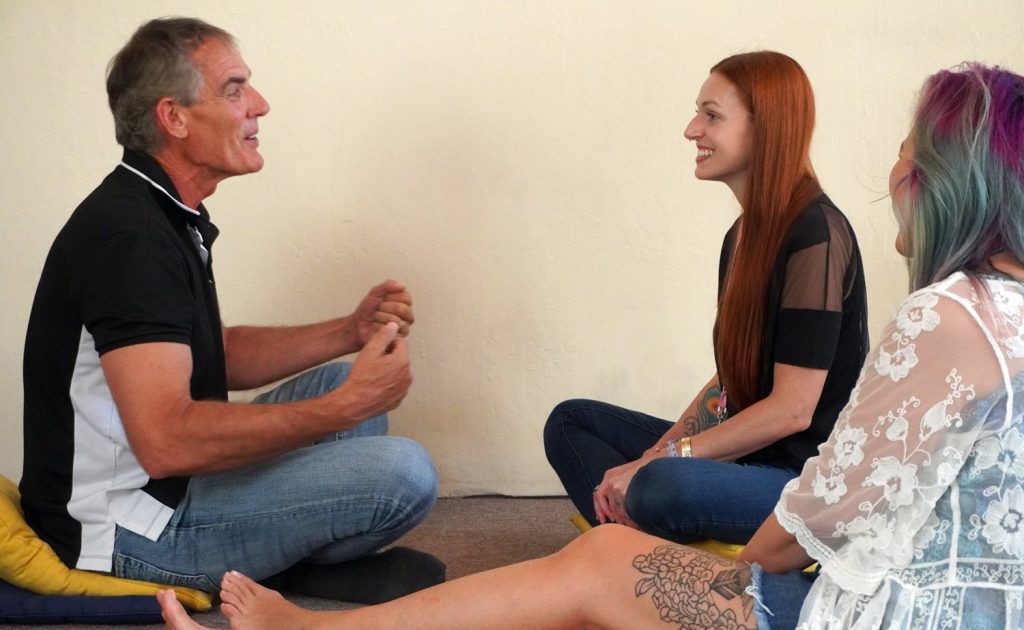
Here is a great example:
Experiential Coaching Exercises
Experiential coaching exercises are designed to help you practice something you want more access to in life.
Take secure attachment. Suppose you know intellectually you want a deeper sense of security with your partner, but you don’t know how to cultivate it. Instead of only discussing your attachment history, the session includes physical connection exercises like holding or cuddling.
The coach then helps you take in that security in a more embodied way, like this:
- You use your breath to consciously invite the connection into different parts of your body, such as your heart, belly, or pelvic floor.
- You pay attention to what secure connection feels like physically – warmth, a sense of being held and supported, or the relief of not having to perform or manage anything.
- This practice teaches your nervous system to recognize security as an experience, not just an idea.
- Over time, you learn to identify that felt sense and carry it into other relationships.
Desire and passionate communication offer another example. Many people want more erotic or emotional intensity in their relationships but have little practice expressing it directly. In an experiential session, you exchange passionate words. One person shares what they’re feeling in the moment, what they want, or what draws them. The other responds with their own feelings, desires, and wants.
You won’t know whether this comes easily or feels difficult until you try it. The coach helps you notice moments of fear and ease, and encourages you to stay with the experience rather than escape it. This way, you develop ways of relating that were previously out of reach.
“I Need a Sex Coach!” – Here’s What to Expect in a Sex Coaching Session
Experiential Coaching vs. Experiential Learning Programs
The phrase experiential learning programs is often used in education, organizational development, leadership training, and corporate settings. These programs may involve simulations, team exercises, case studies, fieldwork, or other forms of active participation designed to improve learning.
Experiential coaching shares the principle that people learn through doing, but the format and purpose are different. A learning program is usually designed around a curriculum that applies to a group of participants. Everyone may move through similar exercises or learning objectives. Coaching is more individualized.
In experiential coaching programs, the experience is shaped around your specific patterns, goals, responses, and relationships. The coach is paying attention to what happens for you in real time and is adapting the session accordingly.
This distinction matters because the Somatica Method is not a corporate experiential learning program. It’s a relational coaching model that uses experience to help people develop more capacity in intimacy, communication, confidence, embodiment, and relationships.
That may include structured exercises, but the exercise itself is not the point. What matters is what happens for you while you are doing it. The coach works with your responses as they emerge.

When You Want Experiential Coaching
Experiential coaching can be useful in these situations:
- You already understand your patterns but still feel stuck in them.
- Perhaps you have trouble asking for what you want and need practice doing it.
- You recognize your tendency to choose emotionally unavailable partners but want to learn what genuine availability feels like.
- Maybe boundaries are a struggle for you, and you need a place to practice saying no without immediately apologizing or explaining.
- Or – your challenge is simply difficult to put into words.
Choose experiential coaching if you learn best through doing. Some people can read extensively about communication and still feel uncertain. They need somatic practice, feedback, repetition, and the chance to experiment in real time.
Experiential coaching can also appeal to people who want their personal growth work to feel more alive and participatory. You are not simply reporting on your life from a distance. You are using the session itself as a place to learn how you respond, what you need, and what becomes possible when you try something new.
At Somatica, experiential work is central because relationships are experiential. Intimacy isn’t learned by thinking about it, and receiving isn’t mastered through analysis. Growing comfortable with desire ultimately means feeling it, expressing it, and noticing what happens.
If you are interested in experiencing this approach directly, you can explore Somatica Sessions to learn more about individual coaching.
If you’re looking for a change of career – or you’re already a coach, therapist, or helping professional – who wants to learn how to use experiential methods in your own work, explore the Somatica Training and its professional certification pathways.

How Sensual Touch Exercises Can Transform Client Relationships
You want purpose. You want freedom. You want to make a difference and a living.
Let’s talk about how.
Meet our Founders in a Free Online Q&A Session! Find out about the latest in cutting-edge sex and relationship coaching and have your questions answered. The next Q&A Session is on Tuesday, September 29, 2026 at 12pm PST
Not ready to join our live Q&A session or can’t make it? You can still save $400 by watching this recorded Q&A (discount code at the end). Or you can reach out to us with questions.