

These Are The Most AI-Proof Careers in 2026

AI can automate a lot of work, but it can’t replace what happens between two people who trust each other. This piece breaks down eight careers — from sex and relationship coaching to nursing to skilled trades — that stay resilient because they depend on physical adaptability, ethical accountability, and genuine human connection.
If you have found yourself wondering which will be the most AI proof careers in the next 5 years, you are definitely not alone.
AI can write your emails and reports, analyze data, answer customer questions, and even create websites and financial plans. Tasks that would have taken us humans endless hours can now be completed in minutes or seconds. And as its capabilities expand, we’re all questioning in a less theoretical and much more personal way: Is my career actually safe?
As always with radical new technologies, the answer is complicated.
What Is an AI Proof Job?
Let’s be honest: very few careers can be called completely AI proof. Technology changes jobs even when it does not eliminate them. But some careers are much harder to automate because of their most important job requirement: human touch.
To put this into context: McKinsey Institute research from November 2025 estimates that today’s AI agents and robots could automate activities for about 57% of current U.S. work hours.
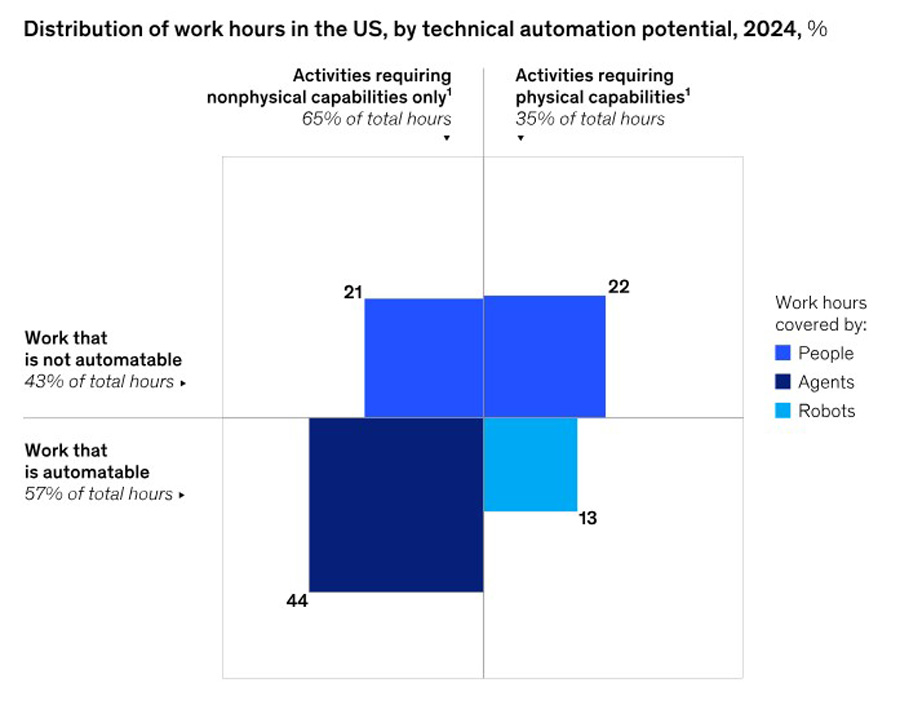
Of course, that does not mean 57% of jobs will disappear. While automation can replace individual tasks, it may be much longer before it replaces entire occupations.
The World Economic Forum’s Future of Jobs Report 2025 instead estimates that labor market changes could displace 92 million but also create 170 million jobs by 2030. 39% of workers’ existing skill sets could be transformed or become outdated. The report also emphasizes that even as AI and technology skills grow in importance, human capabilities such as creative thinking, resilience, flexibility, and agility remain critical.
So instead of asking whether AI is coming for every job, a more useful question is:
What kind of career will require physical or emotional human quality for many years to come (or possibly forever)?
The answer points us toward some of the most AI proof careers available right now.
What Makes a Career Actually AI Resistant?
The safest careers are not necessarily the ones that require the most education or technical expertise.
In fact, as we all know by now, AI and robots are remarkably good at many highly cognitive tasks. The jobs that are much more difficult to automate depend heavily on one or more of these 4 things:
- Physical dexterity in unpredictable environments. Installing plumbing in a 70 year old house is very different from assembling the same object repeatedly on a factory floor. Humans remain particularly valuable when the physical environment is inconsistent and requires constant adaptation.
- Genuine relational trust and empathy. Some work depends on a person feeling safe enough to reveal deeply personal or vulnerable truths about themselves.This requires them feeling trusting towards the person in front of them – not only to keep their confidence, but also to be able to hold their feelings in a way that feels human and caring. Trust and actual human empathy – knowing that the person across from you also has feelings and is not perfect – is not merely a nice addition to the service. It’s part of what makes the service work.
- Ethical or legal accountability. In professions where someone must ultimately exercise judgment, accept responsibility, manage risk, or protect another person’s physical or emotional wellbeing, handing the job to an automated, generic algorithm becomes virtually impossible.
- Creative originality rooted in human culture. AI can generate enormous amounts of creative material. But work that depends on cultural context and sensitivity, lived experience, taste, meaning, and human interpretation remains really hard to authentically create and produce.
Automation research has been showing this to be the case for many years already. In their influential 2013 Oxford Martin School study The Future of Employment, Carl Benedikt Frey and Michael Osborne concluded that jobs requiring creative and social intelligence were among those least susceptible to computerisation. Their model estimated that about 47 percent of U.S. employment at the time fell into a high risk category, while jobs requiring social and creative skills tended to be much more resistant.
More than a decade later, generative AI has become far more capable than the technologies the researchers were assessing, but some things haven’t changed. The underlying question still remains: how much of the value of your work depends on something that can be standardized and codified?
The less it can be automated, the more AI proof the career becomes.

#1: Sex and Relationship Coaching
Sex and relationship coaching may not be the first career that comes to mind when you search for jobs that AI can’t replace. However, it deserves to be very high on the list – particularly if you’re a people person.
Yes, AI can provide relationship advice all day long, for free. You might tell a chatbot about a fight with your partner and receive communication suggestions within seconds. It can explain attachment theory and suggest date night ideas.
However, we all know just having a ton of information does not necessarily lead to any kind of change or transformation. After all – we’ve had the internet since the 1990s.
A skilled sex and relationship coach does not just parrot corrective advice – they:
- watch your face, gestures, and body.
- listen to your words and notice when your body clenches or relaxes.
- observe the moments when you take a breath of relief, have a huge aha, or laugh or cry.
- track the real-time interaction between you and your partner.
- help you practice vulnerability instead of merely explaining it.
- create a human experience that can offer deshamifying, acceptance, and support you while something emotionally significant is happening.
That relationship between coach and client, and especially the sense of attachment and real mutual respect, is part of the intervention. Some experiential sex and relationship coaching methods, such as the Somatica® Method, even include touch as a form of attachment healing, skills-building, and erotic learning that obviously cannot be replaced by AI.
What’s more: most AI chatbots refuse or restrict explicit sexual conversation – a real limitation for anyone trying to work through sexual shame with a bot.
The British Psychological Society addressed the importance of real human intervention directly in a 2026 article called Against the Automation of Intimacy. Its central argument is captured in a simple idea: AI is a tool, not a relationship. The concern is especially relevant when technology moves from helping with information or productivity into trying to simulate the human relationship itself.
Sex and relationship coaching has another advantage for someone considering a career pivot. Unlike becoming a licensed psychotherapist, it does not require returning to university for a multiyear graduate degree and licensure process. High quality professional training can provide a more accessible path into relational work for people ready to change careers.
So for someone suited to a helping profession, sex and relationship coaching is one of the more interesting future proof careers to have on your radar.
#2: Licensed Therapists and Mental Health Counselors
Licensed therapists make the top of the list for many of the same reasons.
AI can provide psychoeducation and structured exercises. Digital mental health tools will almost certainly become more sophisticated over the next years. But effective therapy also depends on therapeutic alliance, judgment, ethics, context, boundaries, risk assessment, and professional accountability.
The Oxford study’s extremely low automation estimate for marriage and family therapists is one early data point supporting the resilience of mental health professions. A therapist is also legally and ethically accountable in ways a general purpose chatbot is not. For complex psychological work, that difference matters.

#3: Physical Therapists and Occupational Therapists
Physical and occupational therapy combine knowledge with something AI struggles to reproduce in the physical world: hands on, continuously adjusted interaction with an individual human body.
A physical therapist does not simply prescribe an exercise. They observe movement, assess pain, feel resistance, notice compensation patterns, modify an intervention, and respond to what happens next. Every body is different and every session generates new information.
Frey and Osborne estimated only a 2.1 percent probability of computerisation for physical therapists, once again placing the occupation near the low risk end of their ranking.
Technology will no doubt enhance physical therapy in the future. It’s much harder to imagine it removing the human practitioner altogether.
#4: Skilled Trades
Electricians, plumbers, HVAC technicians, carpenters, and other skilled trades represent a different kind of AI resistance.
The protection here comes less from emotional connection and more from physical unpredictability.
A plumber entering a home has to diagnose a problem inside a physical system that may have been installed decades ago. It’s likely been modified repeatedly, damaged, concealed behind walls, or built in a way that no diagram perfectly captures.
Robots perform brilliantly in controlled environments. Real houses, construction sites, crawl spaces, roofs, and electrical systems are considerably less cooperative.
Skilled trades also offer an appealing career pivot because many do not require a traditional four year college degree. Apprenticeships, vocational training, certifications, and licensing can create relatively direct paths into well-compensated work.
For someone searching specifically for high paying jobs that AI can’t replace, these trades deserve serious consideration.

#5: Nurses and Nurse Practitioners
Nursing combines technical skill, physical care, clinical judgment, ethical responsibility, and human connection.
AI can assist with documentation, monitoring of data, identifying risks, and helping clinicians make decisions. What it cannot replace is the nurse standing beside a frightened patient, noticing a subtle change in their condition, deciding something is wrong, advocating with another clinician, and helping a family understand what happens next.
Frey and Osborne’s model put registered nurses at only a 0.9 percent probability of computerisation. That does not mean nursing will remain technologically unchanged. It means much of the value of nursing lies beyond information processing.
#6: Social Workers and Case Managers
Social work frequently happens in exactly those circumstances automation handles poorly: emotionally intense, culturally complex, and highly unpredictable. A case manager might simultaneously be navigating housing insecurity, family conflict, government systems, mental health concerns, financial hardship, disability, substance use, and child welfare.
Their success often depends on building enough trust that another person will remain engaged with support in the first place.
AI may become very useful for locating resources, completing paperwork, documenting services, and navigating bureaucratic systems. But the relationship between the professional and the person in crisis is impossible to replace.

#7: Mediators and Conflict Resolution Professionals
Conflict looks logical from the outside. Inside the room, it rarely is.
A mediator needs to hear what people say while also tracking what they avoid saying. They observe where power sits in the room, what escalates each person, whether an agreement is genuine, or when pushing toward resolution is actually useful.
That requires attunement, judgment, cultural awareness, and the ability to respond to dynamics unfolding second by second.
AI may become excellent at proposing compromises. Getting two angry human beings to trust the process enough to reach one is another job entirely.
#8: Early Childhood and Special Education Professionals
Sure – it’s tempting to think AI will replace teachers because education contains many tasks AI can already perform. It can explain algebra, generate lesson plans, tutor students, and adapt exercises to different skill levels.
But a skilled educator notices that a normally engaged child has withdrawn. They recognize the difference between defiance and overwhelm. They help a dysregulated child settle enough to participate. And they can adjust to developmental, sensory, cognitive, and emotional needs while managing an entire room.
Again, AI can become an extraordinary educational tool. The strongest educators will probably use it. But the tool and the teacher are doing different jobs.

The Common Thread Across All of Them
The most useful way to think about AI proof careers is not to search for jobs where technology will never appear. Those jobs may barely exist.
Instead, look for careers where AI can make the human professional better without making the human unnecessary. Across all of the above described roles, the same pattern appears again and again.
The work happens in unpredictable environments. It requires adaptation and involves responsibility. And, in many cases, another human being needs to trust you. That may become one of the most important dividing lines in the future of work.
The World Economic Forum expects technology to transform a substantial portion of existing skills by 2030, yet it simultaneously predicts significant job creation and continued demand for distinctly human capabilities. McKinsey likewise finds enormous potential for automation at the level of individual work activities without predicting the wholesale disappearance of human work.
The question, then, is less “Which jobs will AI never touch?” And a better one is:
Where will another human being still matter enough that people will want one in the room?
If you are planning your next career around that question, relational intelligence, human judgment, adaptability, and genuine connection are very good places to start. Sex and relationship coaching combines all of them.
You want purpose. You want freedom. You want to make a difference and a living.
Let’s talk about how.
Meet our Founders in a Free Online Q&A Session! Find out about the latest in cutting-edge sex and relationship coaching and have your questions answered. The next Q&A Session is on Tuesday, October 13, 2026 at 12pm Pacific Time
Not ready to join our live Q&A session or can’t make it? You can still save $400 by watching this recorded Q&A (discount code at the end). Or you can reach out to us with questions.